Ernährung
Mitochondria: cell power against chronic fatigue – more energy every day
Do you know that? Have you actually slept enough, but still feel like you're going through the day with the handbrake on? This feeling of inexplicable exhaustion often has a deeper, cellular cause. The key to your energy lies in your mitochondria – the tiny power plants in your cells. If your performance decreases, you feel […]
Do you know that? Have you actually slept enough, but still feel like you’re going through the day with the handbrake on? This feeling of inexplicable exhaustion often has a deeper, cellular cause. The key to your energy lies in your mitochondria – the tiny power plants in your cells. If your performance declines, you will feel it as chronic fatigue, which can literally paralyze your everyday life.
# Your energy source lies in your cells

It’s best to imagine your body as a huge, pulsating city. Every single cell is a building that needs electricity to function. And in each of these buildings? There are thousands of small power plants working at full speed - these are your mitochondria. Their job is to convert the nutrients from your food into our body’s universal energy currency: adenosine triphosphate (ATP).
Without enough ATP, your muscles can’t work properly, your brain can’t think clearly, and your immune system weakens. You don’t just feel tired, but profoundly and fundamentally exhausted.
# Why your cellular batteries are dying
Our modern lifestyle is often the greatest enemy of our mitochondria. There are a number of factors that impair their function and reduce the all-important ATP production. You can feel the result directly as a lack of energy.
The most common energy thieves include:
- Chronic Stress: Imagine you’re constantly on the run from a saber-toothed tiger - that’s what chronic stress feels like to your body. The constant tension floods your body with cortisol, a hormone that can actually damage the mitochondria over time.
- Lack of sleep: When you sleep, your cells and mitochondria repair and regenerate themselves. If this crucial phase is missing, it’s like never charging your phone overnight - the battery gets weaker and weaker.
- Nutrient deficiency: Certain vitamins and minerals such as B vitamins, magnesium or coenzyme Q10 are absolutely essential for energy production. If they’re missing, it’s like trying to fill a car with the wrong fuel - the engine stalls.
- Environmental toxins and lack of exercise: Pollutants and a primarily sedentary lifestyle put additional strain on your cells and slow down the function of your mitochondria.
All of these stresses cause your cellular batteries to no longer be fully charged. The result is this leaden tiredness that simply cannot be dispelled by just one night of sleep.
This is the key point: Chronic fatigue is rarely just a feeling. It is often a direct biological signal that shows you that your cells can no longer produce the energy your body needs for an active everyday life.
# You are not alone in your exhaustion
If you constantly feel powerless, you are part of a growing group. The CSS Health Study 2025 showed that a shocking 69 percent of 18- to 35-year-old Swiss suffered from exhaustion and fatigue last year. A main reason for this is that when mitochondria are slowed down by stress or nutrient deficiency, ATP production drops dramatically - and that is exactly what explains this debilitating exhaustion. You can find out more about the study results in the article on Gesundheit junger Erwachsener auf css.ch.But the good news is: you can regain control of your cellular energy. You are not helpless at the mercy of these empty batteries. By understanding the causes and applying targeted strategies, you can get your mitochondria back into shape and renew your energy from the ground up. This article shows you how to recognize the warning signals and activate your cell power against chronic fatigue.
# How to correctly interpret your body’s warning signals

Chronic fatigue is so much more than just feeling tired after a short night’s sleep. It’s an all-pervasive exhaustion that covers your everyday life like a heavy cloak and takes hold of you. When your mitochondria, your little cellular power plants, are no longer running at full speed, your body sends you pretty clear warning signals.
The key is not to ignore these signals, but to interpret them correctly. You must learn to differentiate between normal, temporary fatigue and a deeper cellular problem. Only when you really understand the language of your body can you take targeted countermeasures and reactivate your cell power.
# The telltale core symptom: post-exertional malaise
Do you know that? You make a seemingly small effort - a walk, a focused meeting - and then feel like you’ve been hit by a truck for days afterwards. This phenomenon is not a fantasy, it has a name: Post-Exertional Malaise (PEM). It’s probably the clearest sign that your mitochondria are seriously out of sync.
Imagine your body reacting to climbing stairs as if you had just run a marathon. This is exactly what PEM feels like. It is a massive, often delayed deterioration in your condition after physical, mental or emotional stress. This extreme reaction is not imaginary, but has a tangible biological cause.
PEM is the key symptom that your cells can no longer meet their energy needs after stress. Your mitochondria are simply no longer able to produce new ATP quickly enough. The result is a real energy crash.
Unfortunately, this symptom is more common than you think. In Switzerland, experts estimate that between 17,000 and 34,000 people are affected by chronic fatigue syndrome (CFS), in which mitochondrial dysfunction is often the root of the problem. The day-long exhaustion observed with PEM can be attributed to up to 50% reduced ATP production in the mitochondria. You can read more about this widespread condition in this Blick article about chronic exhaustion.
# Other important warning signals from your body
In addition to PEM, there are a number of other signs that often appear in the package and indicate weakened mitochondria. They not only affect your body, but also your head.
Listen to yourself and see if the following sounds familiar to you:* Brain Fog: Are you having a hard time concentrating? Does your brain feel like it’s working through thick fog? Memory lapses and difficulty finding words are classic signs that your brain is under-supplied.
- Muscle Pain and Weakness: Your muscles are true mitochondrial hotspots. When these weaken, you often feel this through unexplained muscle pain, cramps or a leaden feeling in your arms and legs.
- Low stress tolerance: Do you become irritated more easily, emotionally overwhelmed or does stress throw you off track much more quickly than before? A low stress tolerance is typical, because stress regulation also consumes an incredible amount of cellular energy.
- Sleep disorders: The biggest contradiction: Even though you are dead tired, you cannot find deep, restful sleep. Many people wake up in the morning feeling just as exhausted as the night before.
If these signals sound all too familiar to you and they are massively restricting your everyday life, it’s time to take a closer look. They are your body’s unmistakable cry for help that your energy reserves are empty on a cellular level - and that it is time to seek professional support.
# Strengthen your mitochondria through smart exercise
Exercise is probably the most powerful lever you have to increase the number and performance of your mitochondria. But this is exactly where many people make a crucial mistake: chronic fatigue is not about completely exhausting yourself. It’s about setting the right, smart stimuli that stimulate your cell power plants to grow instead of overloading them.
Once you understand this mechanic, exercise goes from being a chore to being your strongest ally against fatigue. Certain training methods essentially give your cells the command to build new and stronger mitochondria - a process known as mitochondrial biogenesis.
# High-Intensity Interval Training (HIIT) as a spark
One of the most effective methods to stimulate this regeneration process is High-Intensity Interval Training (HIIT). The principle behind it is brilliantly simple: you alternate between very short, extremely intense stress phases and equally short recovery phases.
Imagine giving it your all for 30 seconds - whether sprinting, riding a bike or doing simple bodyweight exercises. Immediately afterwards, treat yourself to a short break. This abrupt change from maximum demand to recovery signals to your muscle cells an acute lack of energy.
Your cells interpret this short, intense stress as an alarm signal. Their reaction to this is pure survival strategy: They begin to produce more and more powerful mitochondria in order to be better prepared for the next challenge.
This targeted training stress is the exact opposite of chronic everyday stress. While constant stress destroys your mitochondria, HIIT challenges them to become stronger. You literally force your body to upgrade its energy infrastructure. You can read more about this in our article 10 Power-Gründe zeigt, warum hochintensives Training dein Leben verändern wird.
A typical HIIT workout like we do at Templeshape might look like this:* Warm-up: 5 minutes easy warm-up to prepare the body.
- Workout block (multiple rounds):
- 45 second burpees (maximum intensity)
- 15 second break
- 45 second kettlebell swings (maximum intensity)
- 15 second break
- Cool-down: 5 minutes of stretching to cool down.
Just a few such sessions per week can noticeably increase the number of your mitochondria and thus raise your basic energy level.
# Yoga as a regulator for efficiency and stress reduction
But it doesn’t always have to be full throttle. While HIIT increases the number of your mitochondria, gentler methods like yoga can significantly improve their efficiency. Especially when it comes to chronic fatigue, a balanced approach that combines both is often the key to success.
Yoga works on a completely different but equally important level for your cellular health:
- Stress reduction: Through mindful movements and conscious breathing, you actively reduce your cortisol levels. Less stress means less continuous firing for your mitochondria, leaving them more capacity for energy production.
- Better Oxygenation: Deep, controlled breathing techniques (Pranayama) improve oxygen saturation in the blood. More oxygen for the cells means that your mitochondria can produce ATP more efficiently - they run cleaner and more smoothly.
- Increased blood circulation: The flowing movements in yoga promote blood circulation down to the finest blood vessels. This way you ensure that nutrients and oxygen actually arrive where they are needed: directly in the cell.
A smart plan like the one we pursue at Templeshape combines these two worlds. For example, you could do a challenging HIIT or boot camp workout twice a week to stimulate the production of new mitochondria. On the other days, support your body with a regenerative yoga session to reduce stress and optimize the efficiency of your existing power plants.
This mix ensures that you challenge your body but never overwhelm it. That’s exactly what makes the difference: you use the positive training stress to become stronger and avoid the harmful constant stress that burns you out. This is how you rebuild your energy from scratch – cell by cell.
# Use the power of breathing and cold for your cells
Movement is a huge lever for your cellular power plants. But there are other, at least equally effective, ways to specifically awaken your mitochondria and renew your energy from the ground up. Your cells react extremely sensitively to targeted, positive stress stimuli - and two of the most powerful tools for this are conscious breathing and cold.
These techniques may sound intense at first, but they act like a reboot for your entire cellular system. They help you relieve stress at the deepest level and boost energy production right from the source.
# Breathwork as a direct line to your energy
Breathing is so much more than just taking a breath. It is your direct switch to regulate your nervous system and flood your cells with energy. Through targeted breathing techniques, also known as Breathwork, you can consciously increase the oxygen saturation in your blood. Why is this so important? Oxygen is the crucial fuel for your mitochondria.Imagine supplying your cells with exactly what they need most for ATP production. Techniques like Wim Hof breathing—a form of controlled hyperventilation followed by periods of holding your breath—create brief, intense physiological stress. This stimulus trains your cells to use oxygen much more efficiently and become more resilient overall.
By breathing consciously, you actively take control of processes that would otherwise be completely automatic. You give your mitochondria exactly the impulse they need to get out of an energy low and noticeably increase their performance.
# The transformative power of ice bathing
Just like breathing, targeted cold also acts as a strong, positive stimulus for your cells. A brief immersion in ice-cold water triggers a powerful biological reaction called hormesis. To put it simply: A short, intense stress stimulus forces your body to adapt - and thereby makes it stronger and more resilient.
As soon as your body is exposed to the cold, your mitochondria react immediately. They are encouraged to ramp up heat production, which increases their efficiency. But what is even more important is that this cold stimulus stimulates the mitochondrial biogenesis mentioned above. So your body begins to form new, healthy and efficient mitochondria.
This graphic shows beautifully how targeted stimuli such as HIIT or yoga directly influence your cellular power plants.
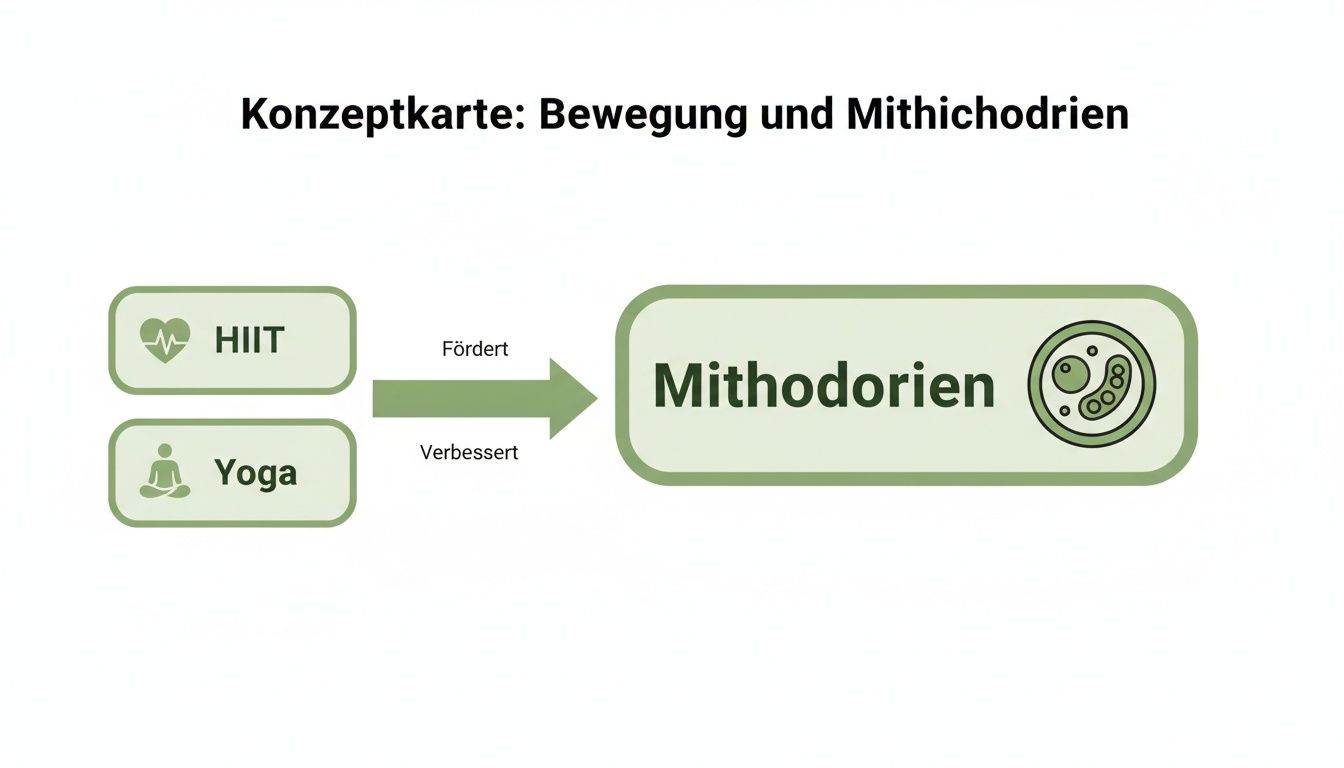
It is clear that a mix of intensive and regenerative methods is needed to comprehensively promote mitochondrial health.
The feeling after a session in the ice bath can hardly be put into words: a wave of clarity, focus and pure energy flows through your body. You feel awake, alive and incredibly powerful. This is the direct result of the activation of your mitochondria and the release of neurotransmitters such as norepinephrine. You can find out more about this unbeatable combination in our offer Fire & Ice bei Templeshape.
The combination of breathwork and cold exposure is an extremely effective strategy for sustainably charging your cellular batteries. You will learn to provide targeted stimuli that do not drain your body, but rather encourage it to improve its own energy infrastructure. This is exactly how you fight chronic fatigue right at its root – in the power plants of your cells.
# Integrate new energy into your everyday life
Knowing the best strategies for your cell power plants is the first, crucial step. But the real magic only happens when you transfer this knowledge into your often hectic everyday life. The best-laid plans are worthless if they don’t fit in with your job, your family, and all your other responsibilities.
This is exactly where we start. This section is your very practical guide for implementation. It’s not about radical changes overnight, but about small, realistic steps. Ones that fit seamlessly into your schedule and, overall, make a huge difference to your energy level.
# Power hacks for working people in Zurich
Your working day in Zurich is scheduled from morning to evening and leaves little room for you? We know this all too well. But this is precisely when small energy islands are absolutely crucial to support your mitochondria and prevent burnout.Here are a few simple but extremely effective strategies for your everyday working life:
- The 15 Minute Lunch Workout: Grab part of your lunch break for a quick HIIT workout. A few rounds of burpees, squats, and lunges in the nearby park—or even in an empty meeting room—will boost mitochondrial production much more than a long, leisurely walk.
- The 3-minute breathing exercise at your desk: When stress levels rise and brain fog sets in, close your eyes for a moment. Breathe in deeply through your nose for four seconds, hold your breath for seven seconds, and then slowly exhale through your mouth for eight seconds. Five repetitions are enough to actively lower your cortisol and flood your brain with fresh oxygen.
- The mitochondrial snack instead of a sugar trap: Instead of reaching for a chocolate bar, opt for a handful of nuts, berries or a piece of dark chocolate (over 85% cocoa content). These snacks provide valuable antioxidants and healthy fats that your cellular power plants love without sending your blood sugar levels on a rollercoaster ride.
These small habits hardly take any time, but they send your body a constant signal: regeneration and energy production are a priority.
It’s about making health a habit, not another annoying task on your to-do list. A smoothie in the morning, a quick stretch before the first call – these micro-habits add up to a powerful routine.
# Sources of strength for mothers in everyday life
As a mother, you juggle countless tasks and your own energy often falls by the wayside. But you need full batteries. The key is to create small, intentional rituals for yourself while the kids are busy or sleeping.
Here are a few concrete tips that really work:
- Morning ritual before the hustle and bustle: Get up just 10 minutes before everyone else. Use this quiet time for a short meditation, a few gentle yoga stretches or simply to drink some tea in peace. This conscious start to the day centers you and protects your cells from the first stress peak.
- Playground workout: While the kids are running around on the playground, you can use the park bench for dips, push-ups or calf raises. Every unit of movement, no matter how small, is a benefit for your mitochondria.
- Community and Regeneration: You are not alone. Offers like the Motherhood Club at Templeshape are specifically designed to give you a space for regeneration. Here you will meet other mothers, take part in customized workouts and get valuable input for your health - an investment in yourself that will benefit your entire family.
In addition to these lifestyle adjustments, you can also specifically support energy production in your cells with certain nutrients. If you want to learn more about how certain coenzymes improve the function of your mitochondria, read our ausführlichen Guide zu NMN (Nikotinamid-Mononukleotid). In this way you create the best conditions for your body to regain its full strength.
# Your path to more energy starts right hereOkay, now you understand the big picture: your energy is directly related to the health of your tiny cell power plants, the mitochondria. You know which warning signals from your body you should listen to and know the clever methods - from HIIT to yoga and breathwork to the cold - to recharge your cellular batteries. Now comes the most important part of the whole journey: the first step.
And don’t worry, this path doesn’t have to be complicated. At Templeshape we have designed everything to make your start as easy and pleasant as possible. We pick you up exactly where you are and guide you step by step to more power and joy in life - without any pressure to perform.
# Find your perfect starting point in Zurich
We know that no two everyday lives are the same. That’s why you’ll find us at two central locations in Zurich that can be seamlessly integrated into your day. Each place has its own character, so you can find exactly what you need at that moment.
- Templeshape CITY: Right in the heart of Zurich, right on the pulse of the city. This is your spot for powerful, energetic workouts. Here you can really boost your mitochondrial production during your lunch break or after work with HIIT, boot camp or Hyrox and simply shake off the stress of the day.
- Templeshape AIRPORT: In the relaxed atmosphere of our studio at the airport you will find the perfect space for regeneration and mindfulness. Classes like yoga and Pilates help you shut down your nervous system and optimize the efficiency of your existing cell power plants.
No matter which location you choose, you will always end up in a community that motivates and supports you. With us there is no opposition, just the common goal of living life healthier and full of energy.
# Take the first step – without obligation
Best way to find out if our approach works for you? Just try it out. We want you to get to know us and our courses before you decide on anything.
Your journey to more energy is not a sprint, but a marathon where every single step counts. The most important is the first - and we will help you do it with joy and confidence. Your cellular energy is just waiting to be awakened by you.
Are you ready to recharge your batteries? Then start now with a simple trial training session. Find out which course and location suits you best and feel for yourself what is possible.
Book your trial training with Templeshape now and start your path to new energy today!
# Your questions about mitochondria and energy – short and sweet
As you set out to regain your energy and leave chronic fatigue behind you, questions naturally arise. That’s a good sign! It means you begin to understand your body on a much deeper, cellular level.
To give you a little more clarity and security on this path, we have answered the most frequently asked questions for you here. They are intended to help you avoid typical stumbling blocks and ensure that your efforts to activate the mitochondria as cell power against chronic fatigue are really rewarded.
# How quickly can I expect improvement?That’s probably the question on everyone’s minds. The honest answer: It is very individual and depends a lot on where you currently stand and how consistent you remain. Your mitochondria are not light switches that you just flip on. Their regeneration is a biological process that simply takes time.
Some people notice an initial, subtle improvement after just one to two weeks of consistent change - i.e. with an adapted diet and targeted exercise. Really noticeable and, above all, stable results usually only become apparent after four to twelve weeks. Give your body this time. He must build new, stronger mitochondria and repair damaged cells.
Always remember: You are working to reverse a condition that has often developed over years. Patience is your strongest muscle here. Every small step today is an investment in your energy tomorrow.
# Is there such a thing as “too much” good training?
Oh yes, absolutely! This is one of the biggest pitfalls, especially if you are chronically exhausted. Targeted, short stimuli like HIIT can stimulate the training of new mitochondria, but too much has exactly the opposite effect. When you overwhelm your body before it has had a chance to recover, you create massive oxidative stress.
This stress damages your mitochondria instead of strengthening them and can drive you deeper into exhaustion. Pay close attention to your body’s signals, especially the so-called Post-Exertional Malaise (PEM). It’s that leaden, delayed fatigue that can come hours or even days after an effort. Always adapt your training to your daily form and plan fixed recovery days - they are just as important as the training itself.
# Which nutrients are particularly important for the mitochondria?
Think of your mitochondria as tiny motors. In order for them to run smoothly, they need the right “operating materials”. If these important micronutrients are missing, the entire system sputters.
Here are some of the most important helpers for your cell power plants:
- Coenzyme Q10: A central player in the chain of ATP production and at the same time a powerful antioxidant that protects mitochondria from damage.
- B vitamins: Above all B2, B3 and B5 are the spark plugs for the cellular engine. Without them, nothing works in energy metabolism.
- Magnesium: This mineral is involved in over 300 enzymatic reactions, many of which occur directly in the mitochondria. A deficiency is like a handbrake on your energy.
- L-Carnitine: This amino acid compound is the taxi for fatty acids. It transports them to the mitochondria so that they can be burned for energy.
The basis is always a balanced diet with lots of vegetables, healthy fats and high-quality protein. It is best to discuss with your doctor whether targeted nutritional supplements make sense for you to fill gaps.
Are you ready to systematically recharge your cellular batteries? At Templeshape we accompany you with the perfect mix of activating workouts, regenerative courses and a community that understands and supports you. Discover how to make your health a habit, one cell at a time. Find out more and start your journey on https://templeshape.com.