Fitness
Journaling for athletes: Mental clarity for better performance
Are you training like an animal, giving your all in the gym or on the running track - and yet it feels like an invisible brake is holding you back? Often this brake is not in the muscles, but in the head. Mental strength is not a nice extra, but the foundation for true top performance. And journaling is one of the […]

Are you training like an animal, giving your all in the gym or on the running track - and yet it feels like an invisible brake is holding you back? Often this brake is not in the muscles, but rather in the head. Mental strength isn’t a nice-to-have, it’s the foundation for true excellence. And journaling is one of the most direct ways to get that mental clarity and take your performance to the next level.
# Why your head is the deciding factor
You probably know the feeling: an important competition is coming up and your nerves are fluttering. A training session goes completely wrong and frustration eats away at you. Or the pressure to perform blocks you exactly when it counts.
These mental states are more than just fleeting thoughts. They have very real, measurable effects on your body. Your reaction time becomes slower, your muscles tense, and your endurance plummets.
The connection between mind and body is not some esoteric nonsense, but rather a lived reality in sport. Imagine a soccer player thinking about his last miss when taking a penalty - the likelihood of him missing again increases dramatically. Or think about a hard-hitting HIIT session at Templeshape where, halfway through, you think, “I can’t do it anymore.” This thought alone can sabotage your actual physical performance, even though your muscles still have power.
# Write down the power of your thoughts
This is exactly where a simple but extremely effective tool that professional athletes have long used comes into play: writing down your own thoughts. It’s not about doing deep psychological analysis, but rather creating a conscious ritual that helps you recognize and break through destructive thought patterns.
By putting your thoughts, fears and goals on paper, you give them a form. You shift the inner chaos to the outside and create the necessary space for focus, self-confidence and mental clarity.
This ritual helps you understand your mental processes and finally actively control them instead of being controlled by them. It’s the first, crucial step to releasing this invisible brake and unlocking your full potential. Additional mental tools, such as targeted Unterscheidung zwischen Breathwork und Meditation, can further strengthen this process.
More and more people are realizing that mental fitness is just as important as physical fitness. In Switzerland in particular, the willingness to holistically optimize one’s own performance is higher than ever before. The proportion of people aged 15 and over who exercise several times a week rose from 30 percent in 1994 to an impressive 57 percent in 2020. This development clearly shows that a large part of the population is already investing in physical activity and is open to methods such as journaling. You can find out more about this exciting development in Bericht «Sport Schweiz 2020».
# How to start your journaling without empty pages
The biggest hurdle when starting out? Often the blank sheet of paper or the blinking cursor on the screen. But don’t worry, getting started with journaling is a lot easier than you might think. Forget rigid rules - it’s about finding a way that feels right for you and your everyday life.
The goal is to take away the procrastination and make writing a valuable part of your routine in just five minutes a day. You don’t have to write in-depth analyzes right away.### Choose your first tool
Whether you prefer to work traditionally with pen and paper or prefer a digital solution is a very personal decision. Both methods have their own charm:
- The classic notebook: Writing by hand deliberately slows down your thought process. Studies show that it can help us anchor and process thoughts better. The haptic experience creates a real ritual. For example, you could get a special notebook just for your workouts that you always carry in your gym bag.
- Digital apps: A journal on your smartphone is always with you. Practical functions such as reminders or the ability to add photos make it super flexible for on the go. Imagine sitting in the car for a moment after training and being able to type your first impressions into an app like Day One or Notion.
Incidentally, in Switzerland there is a clear trend towards introspection through technology. According to a study, over 50 percent of the population already uses fitness trackers and health apps; For those under 40, the figure is even around 70 percent. This high willingness to collect data is an ideal prerequisite for discovering journaling as a complementary tool for mental clarity. If you want to know more about it, you can find spannende Erkenntnisse zur digitalen Gesundheitsüberwachung in der Schweiz here.
# Handwritten or digital – which journaling type are you?
Use this direct comparison to find out which method best suits your everyday sporting routine and your preferences.
| aspect | Handwritten Journaling | Digital journaling |
|---|---|---|
| Feeling & Ritual | Creates a conscious, decelerated ritual. The haptic experience strengthens the connection to one’s own thoughts. | Practical, fast and always available. Ideal for short notes between training and everyday life. |
| Flexibility | Less flexible. You need a pen and notebook. Changing entries later is difficult. | Extremely flexible. You can write anytime and anywhere, easily edit entries and add photos. |
| Focus | Promotes concentration. Without digital distractions, you’ll find it easier to dive deep into your own thoughts. | Can be distracting. Push notifications and other apps are just a click away. |
| Organization | Entries are chronological, but searching for specific topics can be laborious. | Easy organization. Thanks to the search function, tags and categories, you can find old entries immediately. |
| Security | Private and safe as long as you keep your notebook in a safe place. | Depends on the app and privacy settings. Cloud backups are convenient, but also a potential risk. |
Ultimately, there is no right or wrong here. Just try both! You may find that you prefer to use an app for quick training notes, but prefer the good old notebook for deeper weekly reflection.
# Your very first entry – very straightforward
Just start. You don’t have to write novels. A few bullet points or short sentences are enough to get the ball rolling.
A simple first entry might look like this: “Today’s workout: HIIT class. Felt strong on the burpees but tired on the lunges. Thought that distracted me: the long to-do list for tomorrow. Goal for the next workout: Focus on breathing during strenuous exercise.”It can be that simple. You reflected on your training, identified a disturbing thought and set yourself a small, doable goal. That’s exactly what it’s about. Your journal is a tool to help you recognize patterns and make conscious adjustments. It is also important that you pay attention to your recovery - small breaks are crucial to staying productive in the long term. Learn more about how you can mit Micro-Pausen dein Burnout-Risiko senken.
The following graphic will help you better understand the origins of mental blocks in sport and find initial solutions.
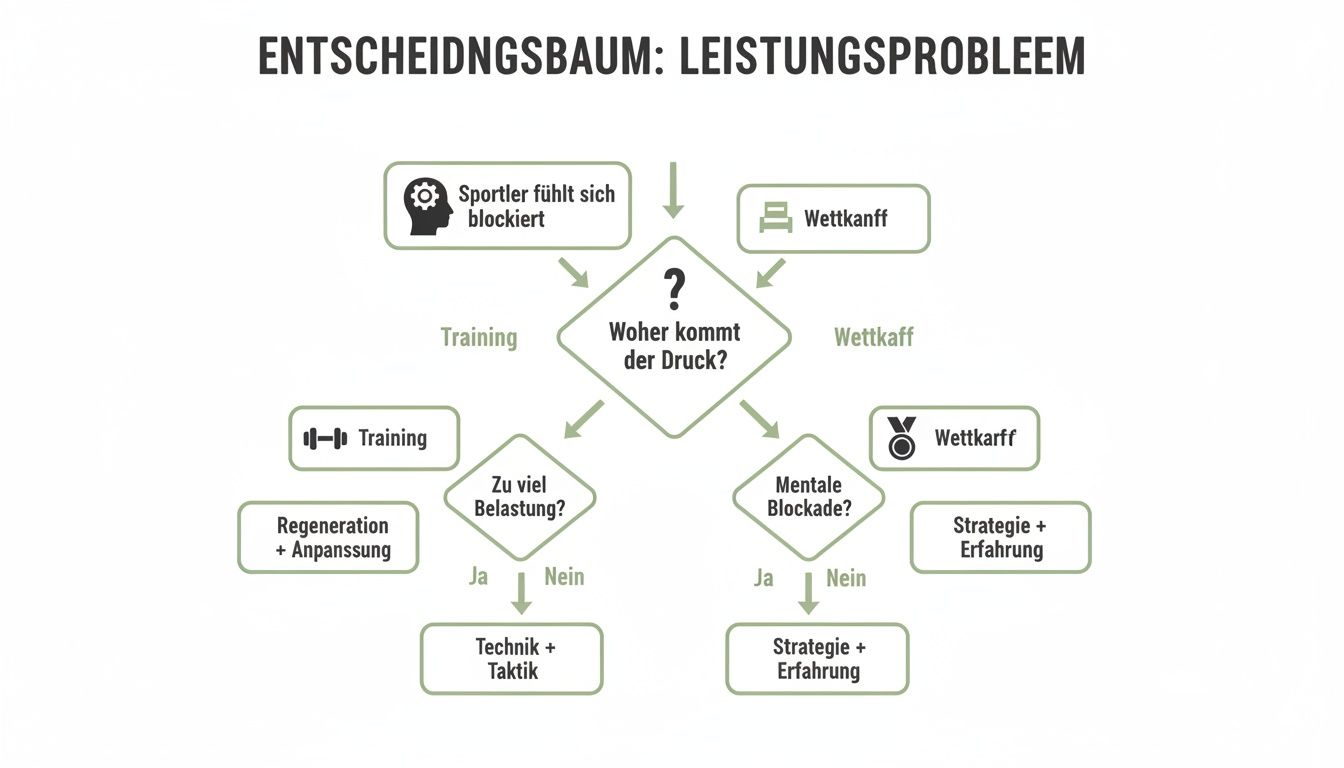
She shows how you can use targeted questions to find out whether the pressure comes from the training itself or from the competition context. A great tool for your first attempts at analysis.
# The right questions for targeted performance improvement
What exactly do you write in your journal now so that it really makes a difference? A blank page can be quite intimidating, I know that too. That’s why this section is your personal list of questions that turns your notebook from a simple diary into a real, strategic training partner.
Instead of general phrases, you get very specific writing suggestions – so-called prompts – that are specifically tailored to the needs of athletes like you. These questions will help you look beyond just the training plan and put together the mental puzzle pieces of your performance. They are the key to deeper mental clarity for greater performance.

# Analysis of your training sessions
Every training session, whether it went great or was an absolute disaster, contains valuable lessons. With the right questions, you will learn to objectively evaluate your performance and recognize patterns. You’ll be surprised how often mental factors influence your physical condition.
How to turn observations into tangible insights:
- What was the highlight of my workout today and why? Find the exact moment when you felt strongest or most focused. Was it a specific exercise, a thought or a feeling? For example: “The moment when I did the last set of squats when I thought I couldn’t do it and then did it. The feeling afterwards was unbeatable.”
- What thought slowed me down or distracted me today? Be brutally honest with yourself. Was it the fear of the last set of squats, the thought of work, or just self-doubt?
- On a scale of 1 to 10: What was my energy level before, during and after training? This simple assessment helps you discover connections between your everyday life and your performance.
- What would I do differently next time to make this training even better? Formulate one specific, small adjustment - this sharpens your focus for the future.
This targeted reflection helps you get the most out of every single session. You learn to train not only your body, but also your mind.
Your journal is your personal coach who tells you the unvarnished truth. It shows you your strengths, but also mercilessly exposes your mental weak points - and that’s exactly the first step towards improvement.
# Focus on regeneration and energyReal performance doesn’t just happen in the gym, but especially in the breaks in between. Your regeneration and your energy balance are the secret stars of constant progress. Use your journal to listen to your body’s often quiet signals.
Unmask energy thieves and optimize your recovery with these questions:
- How did I sleep last night? Note not just the duration, but above all the quality. Do you feel refreshed or more exhausted? An example could be: “Only slept 6 hours, feeling really tired in training today. Note to self: Go to bed earlier tonight.”
- What gave me energy and what drained me of energy today? Think beyond your workout. Was it a good conversation, a nutritious meal, or an annoying task at work?
- What signs of fatigue or overwork do I feel in my body? Pay attention to the little details like muscle twitching, difficulty concentrating, or a short fuse.
By noting these aspects, you develop a keen sense of your body’s needs. You will recognize much earlier when you need to shift down a gear in order to remain productive in the long term.
# Strengthening your mental mindset
Your inner attitude often decides whether you win or lose, whether you reach a goal or give up prematurely. Journaling is an incredibly powerful tool for consciously shaping your mindset, gaining motivation and making your goals truly tangible.
Sharpen your mental focus with these suggestions:
- Visualization: Describe in great detail how you will achieve an upcoming goal. How does it feel to cross the finish line or lift the new weight? Feel the emotions that arise. For example, imagine the smell of the gym, the sound of people cheering, and the feeling of triumph.
- Dealing with setbacks: What setback did I experience this week and what did I learn from it? Focus on the lesson, not the frustration.
- Motivation: Why am I even doing this? Reconnect with your inner drive. What is the big goal behind all the effort?
- Self-talk: What sentence did I say to myself during an effort today? Was he supportive (“Come on, you can do it!”) or negative (“I can’t do it anymore!”)?
Your inner dialogue has a massive impact on your performance. Studies show that athletes who consciously use positive self-talk experience improved concentration and reduced anxiety during competition. Your journal will help you turn that inner critic into a true ally.
# This is how journaling becomes your regular routine
You have the right questions, you know what you want to write - but the best method is of no use if it doesn’t become a habit. Especially for us athletes, consistency is the key to success, both in training and in mental work. Here, I’ll show you a few tried-and-tested strategies for how you can effortlessly integrate Journaling for Athletes into your busy schedule without it feeling like another chore.
The biggest hurdle is often the thought that it will take forever. But the opposite is the case: it’s not about long essays, but rather short, focused moments of reflection.

# Your 5-minute evening reflectionImagine coming home from an intensive boot camp at Templeshape. Your head is still full of impressions, your muscles are tired. Instead of immediately reaching for your cell phone or turning on the television, take exactly five minutes for your journal.
This short moment helps you to consciously end the day and secure valuable insights for your next training.
- Answer only one question: “What was my biggest challenge today and what did I learn from it?”
- Celebrate a small victory: “What am I most proud of today?”
- Let go of the day: Write down what’s still bothering you to clear your head for a restful night.
This simple routine prevents valuable lessons from being lost in everyday stress and promotes the all-important regeneration.
# Your 10-minute morning plan
Morning is the perfect time to mentally align yourself with your goals. A 10-minute journaling session, perhaps over your first cup of coffee, can set the tone for the entire day and give you the mental clarity you need to perform better.
Focus on what’s coming and your intentions:
- Set daily goal: “What is the one thing I want to achieve in my training today?” For example: “Today I want to pay attention to clean technique when doing the squats, even if the weight is lighter.”
- Mental preparation: “What attitude do I want to start the day with today?”
- Visualization: Briefly describe how you will feel when you achieve your goal.
This short but powerful exercise is like a mental warm-up. You program your mind for success and focus before the day has even begun.
Especially in uncertain times, it has become clear how important stable routines are. The “Sport Switzerland light” 2022 report showed that the COVID-19 pandemic had a negative impact on the sporting behavior of 34 percent of the Swiss population. This underlines how crucial mental anchors like journaling can be in keeping motivation high even in difficult phases.
# Small tricks with a big impact
Building a new habit takes more than just willpower – it takes clever systems. Try integrating journaling into your existing processes:
- The Visual Anchor: Place your notebook right next to the coffee machine, on your nightstand, or in your gym bag. This way you will be automatically reminded.
- The digital nudge: Set up a recurring appointment in your calendar - for example “5 Min. Journaling” every evening at 9:00 p.m.
- Pair it to a habit: Always write right after you brush your teeth or before you put on your running shoes.
Writing becomes a natural part of your day. If you would like to delve deeper into the mechanisms of habit training, you will find even more valuable tips in our umfassenden Guide zum Aufbau neuer Gewohnheiten. Start small, stick with it, and you will quickly notice how this ritual advances your athletic and mental development.
# Growing together with the Templeshape Community
Mental strength is not a one-on-one battle. The energy that comes from surrounding yourself with like-minded people is an incredibly powerful engine for your personal development. This is exactly the power we use at Templeshape to take your journaling practice to the next level and strengthen your mental clarity for greater performance.It’s about exchanging ideas, learning from each other and becoming stronger together - that’s exactly what the atmosphere at Templeshape is all about.
# Exchange as a motivation booster
A short conversation after an intensive boot camp or a shared moment of reflection after a yoga session can often have more effect than hours of pondering alone. That’s exactly when you realize: you’re not alone with your mental hurdles.
That’s why we at Templeshape plan to specifically integrate journaling into our programs and workshops in the future. In this way we create a protected space in which we can train not only our bodies but also our minds.
# Find your accountability partner
One of the most effective ways to stay on track is with what is known as an accountability partner. Find someone in the community with whom you can talk regularly and without pressure about your progress and challenges in journaling.
Exchanging ideas with a partner helps you sort your thoughts and consolidate your insights. It’s not about control, but about mutual inspiration and support on an equal level.
Imagine sharing an insight from your journal about a performance slump and your partner replies, “I totally know it! It helped me reset my focus.” Such moments are worth their weight in gold and strengthen your motivation immensely.
# Share ideas and benefit from each other
The Templeshape Community is a huge treasure trove of experience and knowledge. Use this space to inspire each other - not just in training. You can exchange mental strategies or recommend a passende Geschenkidee für Sportler to each other when another birthday comes up.
Our focus is on mutual growth. Speak openly about what concerns you. Maybe you’ll discover new journaling questions together or motivate each other to stick with it even on days when you don’t feel like it. This connection is key to establishing sustainable habits and building the mental strength essential for peak performance.
# Frequently asked questions about journaling for athletes
Are you thinking about starting journaling, but you still have a few questions floating around in your head? Perfect. Here we clear up the typical uncertainties so that you can get started without hesitation and find the mental clarity that will really take you further in your training.
# How much time do I have to invest every day?
Good news: Forget the pressure of having to write page-long novels. Just five to ten minutes a day will make a huge difference and give you the mental clarity you’re looking for.
What matters is the regularity, not the duration. Think of it like brushing your teeth – a small, consistent habit. Some days your thoughts may just flow out of you, while others you just write down three bullet points about how you feel. Both are worth their weight in gold.
# What to do if you have writer’s block?
The blank page staring at you? We all know that. If you don’t know what to write, just pick one of the targeted questions from the previous sections. Choose the one that interests you most at the moment and just start writing without judging the result.
Another technique that almost always works is so-called “freewriting”:* Set a timer for exactly three minutes.
- Write down everything that comes to mind – completely unfiltered. Even if they are sentences like “I don’t know what to write”. *Don’t stop until the alarm goes off.
This method is a real game-changer for releasing blockages and getting back into the flow of writing.
# Morning or evening – which is better?
There is no general “better” here, just “better for you”. My advice: Just try both and see what fits seamlessly into your everyday life.
Writing in the morning can help you mentally prepare for your workout and goals for the day. It’s like a quick briefing with yourself.
In the evening, however, it is the perfect ritual to clear your head, process the learnings from training and set the stage for a restful sleep.
# Do I have to share my journal with others?
Absolutely no. Your journal is your personal, protected space. Here you can and should be 100% honest with yourself.
Your journal is a confidential dialogue with yourself. This privacy is crucial so that you can reflect and grow without filters.
But sometimes it can be incredibly helpful to share selected insights. Let’s say you notice that a certain exercise keeps triggering mental blocks for you. Talking about this with your coach at Templeshape or a training partner can work wonders. This targeted exchange advances your training without you having to reveal your most intimate thoughts.
Do you want to use the power of community to achieve your mental and physical goals? At Templeshape you will not only find sweaty workouts, but also a supportive community and the right guidance to make lasting changes to your habits. Discover our courses and find out how we can accompany you on your journey: https://templeshape.com