Yoga
Breathing techniques in yoga: Learning pranayama – deep breathing, focus and well-being
There is more to the term pranayama than just “breathing correctly”. It is the conscious art of directing and cultivating your life energy – called prana in yoga – through targeted breathing exercises. Think of it not simply as deep breathing in and out, but as a powerful tool that allows you to directly influence your nervous system […]
There is more to the term pranayama than just “breathing correctly”. It is the conscious art of directing and cultivating your life energy – called Prana in yoga – through targeted breathing exercises. Don’t just think of it as deep inhaling and exhaling, but as a powerful tool that you can use to directly influence your nervous system, reduce stress, and clear your head.
# Why conscious breathing changes your life
You may be wondering how something as mundane as breathing can make such a profound difference to your overall well-being. The answer lies in the thousands of years old breathing techniques of yoga, pranayama. It’s about shifting from unconscious autopilot into the conscious driver’s seat of your inner state.
Your breath is like a remote control for your nervous system. In hectic everyday life, we are often caught in “fight or flight” mode, which is reflected in shallow, rapid breathing. With targeted pranayama you will learn to break this cycle and instead activate the “rest and digest” mode.
# The direct line to your inner peace
The connection between breathing and mental state is not some esoteric nonsense, but pure biology. Slow, deep breathing signals to your brain that everything is okay. This happens primarily through the activation of the vagus nerve, the main player in relaxation and regeneration in our body. If you would like to find out more about how you can deinen Vagusnerv mit einfachen Übungen im Alltag stimulieren, we have further tips for you here.
By consciously directing your breath you can:
- Reduce stress hormones: The levels of cortisol and adrenaline drop noticeably, making you more relaxed. For example, imagine breathing deeply and slowly for five minutes before an important presentation. You will notice how your heartbeat decreases and you become calmer.
- Slow down your heartbeat: A calmer pulse directly leads to a feeling of deep relaxation. You can even measure this with a smartwatch: After a few rounds of alternate breathing, your heart rate visibly drops.
- Create mental clarity: The carousel of thoughts spins more slowly and your concentration improves.
Pranayama is your anchor in the storm of everyday life. It is the tool that you always carry with you to find your center in every situation - be it before an important meeting in Zurich or in a chaotic moment as a mother.
# More than just taking a breath
Pranayama is not just about breathing deeply into your stomach. It is a very nuanced practice with countless techniques, each with a specific effect. Some have an invigorating effect like an espresso in the morning, others have a calming effect like a warm blanket in the evening.
Especially in an urban environment, you may feel the need to find a balance. In fact, the practice of pranayama techniques in yoga in Switzerland, especially in the canton of Zurich, has increased significantly in recent years. According to a study, 68% of employees in Zurich report chronic stress, with 42% citing breathing techniques such as pranayama as effective stress relief.
At Templeshape, we specifically use these powerful techniques to help you build sustainable health habits. We’ll show you how to use your breath as a valuable resource to deepen your yoga practice and experience every day a little more consciously and balanced.
# Four basic pranayama techniques to get you startedWell, now it’s getting practical. Learning breathing techniques in yoga means, above all, experiencing first-hand how you can consciously control your condition. I’ll take you by the hand and guide you through four central pranayama exercises. They are a fantastic foundation for your practice, each with their own unique superpower and perfect moment.
# Ujjayi Breathing – The sound of the ocean within you
The Ujjayi breathing – often translated as “victorious breath” or “ocean breath” – is the rhythmic foundation in many dynamic yoga styles such as Vinyasa or Ashtanga. The trick is to create a gentle, audible whoosh at the back of your throat.
Just imagine breathing on a mirror with your mouth closed. This quiet sound occurs because you are narrowing your glottis ever so slightly. This sound becomes your anchor: it keeps your mind in the here and now while your body flows through the asanas. At the same time, Ujjayi warms you up from the inside and helps you find a wonderfully consistent flow.
Practical tip: In the beginning it is often easier if you hold a hand in front of your mouth and breathe on it with your mouth open, as if you were fogging up a window pane. Feel the warmth. Then close your mouth and try to maintain that exact feeling and sound while continuing to breathe gently through your nose.
# Nadi Shodhana – the balancing alternate breathing
Do you sometimes feel completely scattered or emotionally out of sync? Then Nadi Shodhana is your go-to tool. This alternate breathing is an incredibly powerful tool for bringing your nervous system back into balance - i.e. finding the balance between the activating (sympathetic) and the calming (parasympathetic) part.
To practice, gently close your right nostril with your right thumb and inhale from your left. Then take your ring finger, close your left nostril, open your right one and breathe out again. Immediately breathe in again on the right, close it and breathe out again on the left. That was a full lap.
Just a few rounds can work wonders. They create incredible mental clarity and noticeably reduce stress.
# Kapalabhati – The breath of fire for an energy kick
Do you need a morning kickstart that’s more sustainable than a double espresso? Then Kapalabhati – the “skull-luminous breath” or “breath of fire” – is exactly your thing. This technique is less about calming and more about cleansing and activating.
The entire focus is on a powerful, jerky exhalation through the nose. Imagine that you are suddenly pulling your abdominal wall inwards. The inhalation then happens completely passively, as if the body were taking a breath again on its own. A good image is to imagine that you want to blow a small fly away from the tip of your nose.
- Application: Perfect in the morning to get your circulation going and your head awake.
- Caution: Avoid this technique if you have high blood pressure, heart problems, are pregnant, or are easily dizzy.
# Bhramari – The soothing hum of the bee
Bhramari Pranayama, “bee breathing,” is one of the quickest ways to shut down your system. It is a real blessing when your thoughts are in full swing or you feel overwhelmed by anger, fear or overwhelm.You breathe in deeply and as you breathe out you make a buzzing sound, much like a bee. To enhance the effect, you can gently close your ears with your thumbs and place the remaining fingers loosely on your face. The subtle vibration of the hum has an almost immediate calming effect on the nervous system.
These four techniques are a wonderful toolbox for your everyday life. So that you can keep track of things, I have made a small summary for you.
# Four pranayama techniques at a glance
This table summarizes the most important pranayama exercises for beginners and shows you their main effect and the ideal time to use them.
| Technology | Effect | Best time for practice |
|---|---|---|
| Ujjayi | Centering, warming, focusing | During your yoga asana practice |
| Nadi Shodhana | Balancing, calming, clarifying | At any time, especially when stressed or before meditation |
| Kapalabhati | Energizing, cleansing, invigorating | In the morning or before a mentally demanding task |
| Bhramari | Deeply calming, anxiety-relieving, grounding | In the evening, before sleep or during emotional turmoil |
By discovering these breathing techniques in yoga, you will receive a powerful key. A key with which you can actively contribute to more balance and well-being in your everyday life.
# Your pranayama plan for the first four weeks
The best way to learn pranayama and make it a real support in your everyday life is with a plan that actually works. Instead of overwhelming you right at the beginning with too many techniques and long sessions, we start off very gently. This four-week schedule is designed to fit into even the busiest of schedules - you’ll see how just a few minutes each day can make a huge difference.
The plan builds your practice step by step: We start with the basic Ujjayi breathing and work our way up to the deeply calming Bhramari practice.
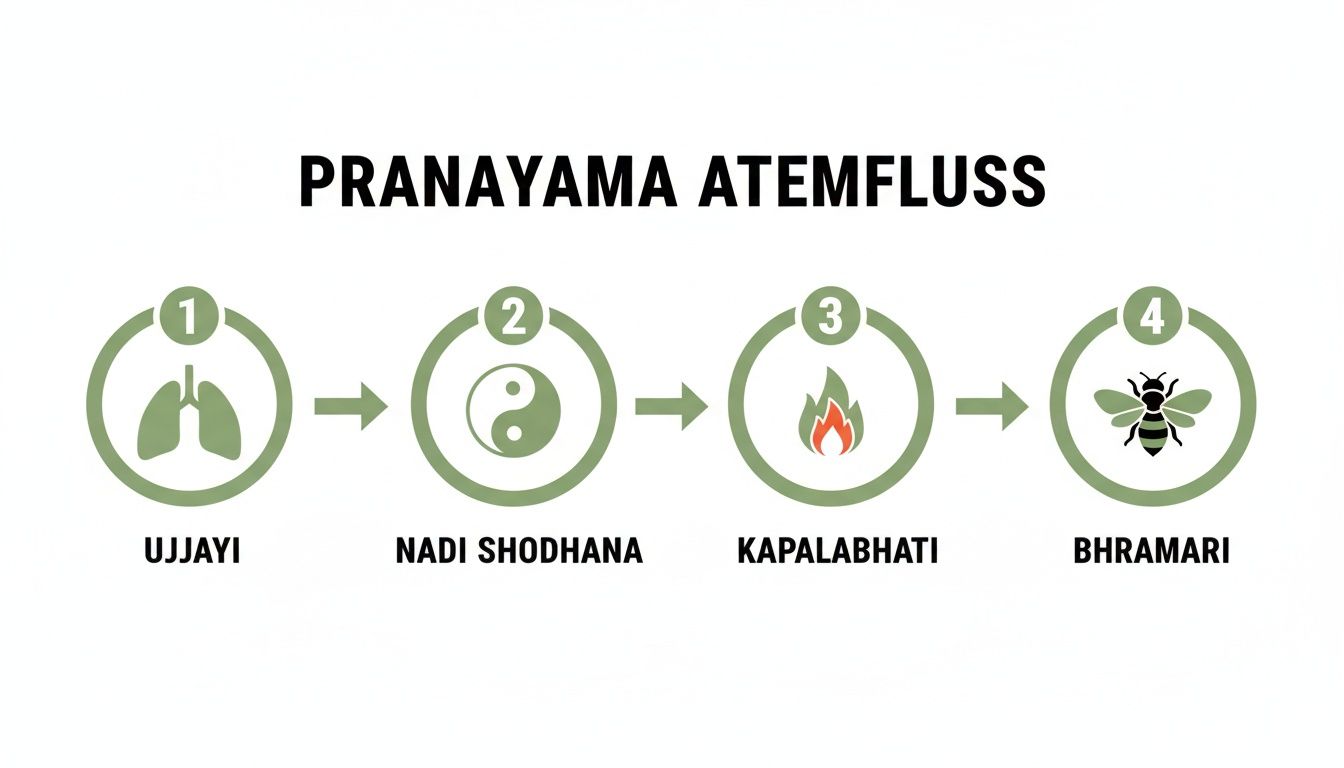
You can see here how each technique builds on the previous one. This will gradually give you a versatile set of tools that you can use as needed.
# Week 1: Focus on the foundation
In the first week we devote ourselves entirely to Ujjayi breathing. Take five minutes of time every day, preferably right after you get up. Sit comfortably, close your eyes and find that gentle, oceanic sound in your throat.
Your only goal? Stay with your breath for five minutes. It’s not about perfection. It’s about developing a feeling for this basic technique and building a small but nice daily routine.
# Week 2: Bring balance into the system
Okay, Ujjayi is sitting. Now let’s add a new element. In week two, you expand your practice to seven to ten minutes daily.
- Minutes 1-3: Start with your Ujjayi breathing as usual. Come to yourself, center yourself.
- Minutes 4-7: Immediately afterwards practice Nadi Shodhana, alternate breathing. Four to five rounds are perfect to start with. If it feels good, feel free to do a few more.
You will quickly notice how the warming Ujjayi breathing and the balancing alternating breathing create a wonderful harmony in your body and mind.
# Week 3: Energy and Cleansing
Now it’s getting more activating! In the third week we integrate a technique that makes you awake and clear. Your practice will now take about ten to twelve minutes. Ideal for the morning.Start again with a few minutes of Ujjayi, followed by a few rounds of Nadi Shodhana. Then add a round of Kapalabhati (the breath of fire) with about 20-30 quick breaths. Very important: Afterwards, feel for a moment in silence.
Kapalabhati is intense, so listen to your body. If you feel dizzy, take a break. The goal is to gently awaken your body, not overwhelm it.
# Week 4: Calming and deepening
In the finale of your first month, we will complete your pranayama toolkit. The practice now takes around 15 minutes. You now have a flexible routine that you can easily adapt to your daily routine.
Now add Bhramari, bee breathing, to the end of your previous sequence. After Ujjayi, Nadi Shodhana and a gentle round of Kapalabhati, take three to five rounds of time for this incredibly calming hum.
After these four weeks, you will not only have learned four of the most effective breathing techniques in yoga, but you will have created a really solid foundation. You now have a repertoire that you can draw from depending on the situation - regardless of whether you need a boost of energy, more balance or deep peace.
# Common mistakes in pranayama and how to avoid them
Your safety and well-being are the be-all and end-all when you start pranayama. These breathing techniques are incredibly powerful, no question about it. But as with any intense workout, there are a few things you should pay attention to so you don’t overwhelm yourself. The good news: If you know the typical stumbling blocks, you can easily avoid them right from the start.
One of the biggest mistakes I see again and again in beginners is forcing breathing. Pranayama is not a competition about who can hold their breath the longest or breathe the fastest. Think of it as a gentle, conscious dialogue with your body.
# Learn to listen to your body’s signals
Your body is constantly talking to you - you just have to learn to listen to it. Do you feel dizzy? Do you feel a tightness in your chest or a sudden, unexplained restlessness? These are clear stop signs. This is not a failure, but a sign of your alertness.
Here are a few common mistakes and how to easily correct them:
- False ambition: You start straight away with 100 breaths at Kapalabhati because you saw it like that somewhere. Better: Start with 20-30 strokes and then take a moment to feel in the silence. The improvement then comes all by itself, week after week.
- Hold your breath like hell: You hold your breath (Kumbhaka) until your face turns blue and everything is tense. Better: Hold your breath only for as long as it feels relaxed and effortless. As soon as the natural impulse to inhale comes, give in gently.
- Tense posture: You frown, clenching your jaw and pulling your shoulders up towards your ears. Better: Consciously relax your face, jaw and shoulders before starting the exercise. A gentle smile can work wonders.
It’s not about doing an exercise “perfectly,” it’s about finding a practice that feels good for you. Less is almost always more here. Your breathing should always feel free and supportive, never forced.
# When certain techniques need a breakNot every breathing technique is suitable for every phase of life or every health condition. Sometimes it is wiser to adapt an exercise or to temporarily avoid it altogether.
Particular caution is required with:
- High blood pressure: Techniques that build up a lot of pressure in the body, such as very intense kapalabhati or long, forced breath holding, are not the best choice here. It is better to focus on balancing and calming exercises such as alternate breathing (Nadi Shodhana).
- Pregnancy: During pregnancy you should avoid all exercises that hold your breath (Kumbhaka) or create strong pressure in the abdominal area. Gentle, deep and conscious abdominal breathing, on the other hand, is a wonderful companion for you and your baby.
Precisely because these details are so crucial, qualified instructions at the beginning are simply worth their weight in gold. In our Templeshape courses we pay close attention to ensuring that you learn the techniques safely and correctly for your body. We create a space where you can try things out and ask all your questions without pressure. This means you feel safe and in good hands with your pranayama practice right from the start.
# This is how Pranayama becomes your superpower in everyday life
At Templeshape we live our motto “Make Health Your Habit” every single day. You always have one of the most powerful tools with you: your breath. Pranayama is so much more than just “breathing deeply”. We’ll show you how to establish these techniques not just in the course, but as an integral part of your active lifestyle.
Integration begins very subtly, directly in our classes. You will quickly notice how we specifically use different breathing techniques in yoga and other courses to deepen the practice and meet you exactly where you are.
# Your breath in our courses
In our dynamic yoga flows, for example, you will encounter Ujjayi breathing. It sounds like the gentle sound of the sea, generates inner warmth and helps you flow through the asanas in a focused and powerful manner. In quieter hours such as Pilates or special breathwork sessions, we slow down a gear. Here we focus on calming techniques that regulate your nervous system and allow you to relax deeply.
But breath also plays a main role in our energetic courses:
- Before the HIIT workout: A few quick rounds of Kapalabhati will awaken your spirits and prepare you mentally and physically for the high intensity. A real energy kick!
- After ice bathing: Targeted, deep breaths are worth their weight in gold here. They help your body warm up quickly and move from cold shock to a state of calm alertness.
Our goal is simple: We want to show you that your breath is your direct line to more energy, balance or relaxation - depending on what you need at the moment. It is the bridge that connects body and mind.
# From the mat into the world
But the true potential of pranayama only unfolds when you take it beyond the confines of the studio. The techniques you learn with us are like little anchors that you can cast out in your hectic everyday life.
Imagine you’re sitting in the office and the classic midday slump hits. Instead of reaching for the next coffee, take three minutes for a few rounds of Nadi Shodhana. You’ll be amazed at how clear and awake you feel afterwards.Or in the evening when your thoughts just don’t want to calm down: five rounds of Bhramari can stop the carousel in your head and gently hum you to sleep. It’s these small, conscious moments that make the biggest difference throughout the day.
This is not esoteric, but has tangible effects. Statistics for the Zurich area show that 52% of yoga practitioners sleep better and reduce anxiety through pranayama. At Templeshape, 62% of our female members report noticeably increased emotional resilience through regular breathing practice.
The integration is really easier than you might think. Whether you book a targeted breathwork session with us or use the exercises at home is entirely up to you. You can find out more about this in our Vergleich von Studio- und Heim-Praxis. This is how your breath becomes your most faithful companion for more balance and well-being - every day.
# Your most frequently asked questions about pranayama
Similar questions about pranayama come up again and again in our Templeshape courses. Here I have summarized the most important ones for you to take away any remaining insecurities and get you on the mat with a good feeling.
# How often do I have to practice pranayama to feel something?
Regularity beats duration – always. Just five to ten minutes a day often does more than you think. Many of our members feel clearer concentration and deeper inner peace after just one or two weeks.
But if you want to sustainably reduce stress and recalibrate your nervous system, make it a permanent habit. Just think of it like brushing your teeth every day for your soul.
# Can I do something wrong with pranayama?
Yes, absolutely. The biggest beginner’s mistake is forcing your breath instead of letting it flow naturally. If you want too much, you can quickly become dizzy or uncomfortable - and of course that is the exact opposite of what we want to achieve.
So approach it slowly and learn to listen to your body’s subtle signals. A good introductory course is worth its weight in gold if you want to learn the technology properly right from the start. The golden rule is: If something doesn’t feel right, stop immediately.
# Which breathing technique helps most quickly with stress?
If you want to get rid of acute stress, alternative breathing (Nadi Shodhana) is incredibly effective. It directly balances your nervous system and acts like a reset button for your entire system.
Bee Breathing (Bhramari) is also fantastic for stopping the carousel of thoughts and calming the mind immediately. Just play with it a bit and find out which of the two techniques works best for you at the moment.
The line between targeted breathing work and meditation is often blurred. If you want to delve deeper into the topic, read more about the Unterschiede zwischen Breathwork und Meditation here.
Ready to feel the power of your own breath? At Templeshape, pranayama is an integral part of our classes to help you develop healthy routines that last. Take a look at our offer and find the right course for you on https://templeshape.com.